

In just two years, organisations have gone from testing AI at the margins to relying on it in the middle of everyday work. AI now drafts what we send, analyses what we decide, and shapes how customers experience us. Usage is exploding. Productivity looks up. But something far more important is unfolding beneath the surface.
A gap is emerging between AI activity and AI impact.
Many organisations report heavy usage but modest improvements in margins, decision speed, or automation at scale. Benefits that appeared compelling in pilots flatten as AI spreads across teams. Senior leaders find themselves more involved in review and validation, not less. Automation timelines slip, even as investment continues.
Prompt Debt accumulates when prompts are created quickly, shared informally, and embedded into workflows without ownership, standards, or economic accountability. What begins as flexibility gradually becomes fragility. Small inefficiencies compound, confidence in outputs declines, and manual safeguards quietly expand.
Strategic Impact of Prompt Debt
These impacts affect growth, margins, and long-term scalability. They are usually discussed at the board and executive level, often without being linked back to prompts.
| Strategic Impact | Lines impacted | Typical Impact | What Leadership Sees |
|---|---|---|---|
| EBITDA margin compression | EBITDA | 2–5 point erosion | AI ROI below plan, margins flatten |
| Revenue upside erosion | Revenue growth | 15–30% of expected uplift lost | AI growth cases revised downward |
| Automation payback delay | Cash flow and ROI timing | 6–18-month delay | Benefits pushed to later phases |
| Cost pyramid inversion | SG&A and delivery cost | 10–20% senior effort uplift | Higher blended cost per unit |
| Decision velocity decline | Opportunity cost | 3–7% slower cycles | Slower execution, more reviews |
Source: Planckpoint research, 2026
Why This Is Not a Skills Problem
Prompt Debt is often misdiagnosed as a training gap. It is not. Well-trained teams still generate Prompt Debt when prompts are treated as informal artefacts rather than as shared organisational assets. Without ownership, lifecycle management, and economic accountability, debt is inevitable.
There is a familiar precedent here. Organisations spent years learning that technical debt constrained agility and margins long after software worked. Prompt Debt follows the same logic, faster, and across a much broader workforce.
How should organisations manage their Prompt Debt?
Prompt Debt accumulates when prompts move from individual experimentation to shared, operational use without ownership, standards, or economic accountability. It does not break AI. It prevents AI from compounding value. Managing Prompt Debt is therefore not a technical exercise. It is an organisational discipline.
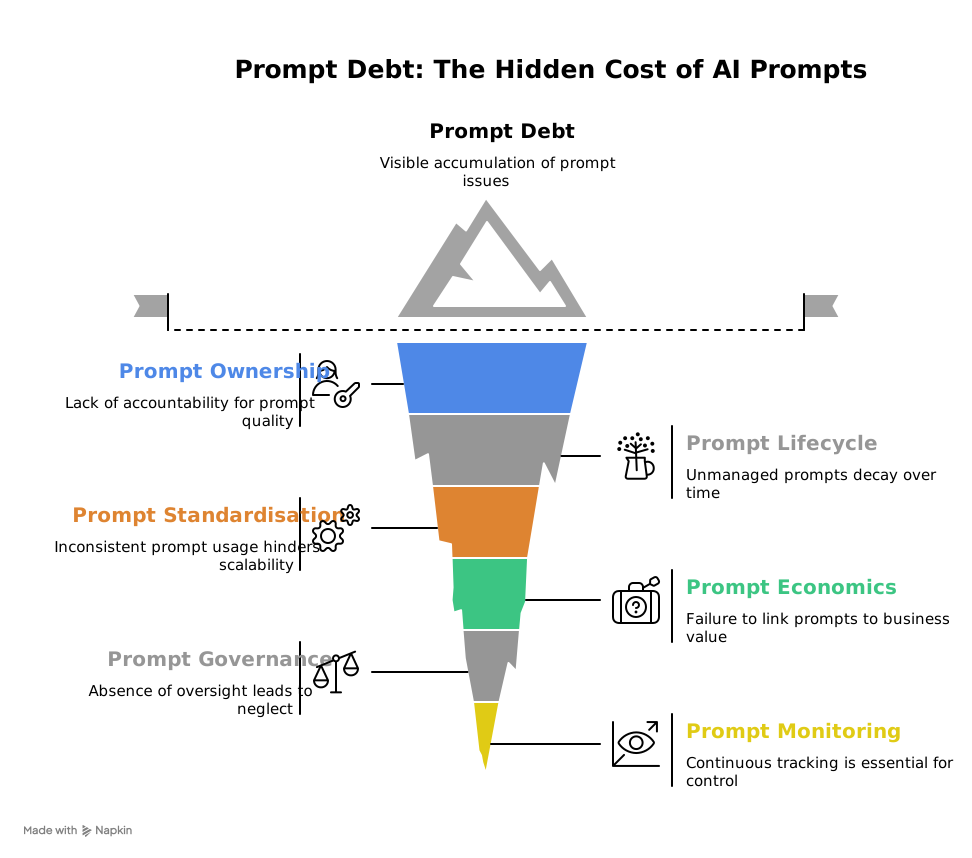
| What Organisations Must Do | Why It Matters | What Changes in Practice |
|---|---|---|
| Treat prompts as assets | Prompts shape outcomes, cost, and risk | High-impact prompts have named owners |
| Measure before fixing | Prompt Debt is unevenly distributed | Intervention focuses on where value leaks |
| Enforce ownership | No owner means guaranteed debt | Prompt changes are controlled |
| Apply lifecycle discipline | Unreviewed prompts quietly decay | Prompts are reviewed and retired |
| Standardise selectively | Scale needs discipline, not rigidity | Core workflows stabilise |
| Link prompts to economics | Quality alone does not change behaviour | Productivity and cost become visible |
| Embed governance | Side programs are ignored | Prompt discipline becomes routine |
| Monitor continuously | Debt compounds as AI scales | Prompt Debt trends down over time |
The Bottom Line
- Prompt Debt is not a technical flaw. It is an organisational cost of scaling AI without discipline.
- AI creates opportunity. Prompt discipline determines how much of that opportunity survives.
- Organisations that manage Prompt Debt early preserve productivity gains, protect margins, and accelerate automation. Those who do not will keep asking why AI feels helpful, but never truly transformational.