

The Shift in Competitive Advantage
Every major shift in the economy has changed what organisations compete on and, in turn, how markets measure value. The industrial economy valued physical capital. The knowledge economy elevated intellectual capital. As competition became increasingly customer-centric, organisations began measuring customer experience. More recently, the digital economy has made cyber resilience, privacy and operational risk strategic assets. Artificial intelligence represents the next structural shift, now reshaping the foundations of competitive advantage.
The Erosion of Knowledge Scarcity
Modern technology has done to knowledge what the internet did to information. For decades, the relationship between enterprises and technology vendors has been built on a single foundation: knowledge. Proprietary frameworks, accumulated pattern recognition, and the confidence that "we have seen this over 200 times across various industries" formed the core of the industry's value proposition. Clients paid a premium for this knowledge because it was scarce, difficult to acquire, and even harder to replicate.
This scarcity is eroding rapidly. Despite having more powerful tools, greater access to knowledge, and more advanced technology than at any other point in its history, the IT services industry has never been questioned more intensely about the outcomes it delivers. Clients are no longer impressed by a provider’s expertise or scale.
The Trust Currency
As technical differentiation narrows, the quality of the relationships and the confidence a provider instils become increasingly central to competitive advantage. Clients expect tangible business outcomes and confidence that those outcomes will be achieved. As a result, evaluating vendors solely through the lens of execution, technical expertise, commercial competitiveness, and delivery maturity is no longer enough. These capabilities remain essential, but they are no longer sufficient to differentiate one provider from another. This is also where traditional evaluation frameworks and quadrants fail to answer the question adequately: ‘Which partner can we trust when the outcome is uncertain?’ In this new environment, judgement, empathy, transparency, accountability, and collaboration become the foundations of trust. And trust itself is emerging as the new economic currency.
Measuring What Matters
At PlanckPoint Research, we believe the next evolution of enterprise assessment lies in measuring Trust Currency - the confidence an organisation earns through its technology, its values, its ability to deliver outcomes and the strength of its relationships. Inspired by Niklas Luhmann's theory that trust reduces complexity, the PlanckPoint Trust Pyramid measures the confidence organisations place in their technology partners throughout the relationship lifecycle.
In an economy where AI is increasingly commoditising knowledge, trust is emerging as the most enduring source of competitive advantage, and one of the few assets that competitors cannot easily replicate.
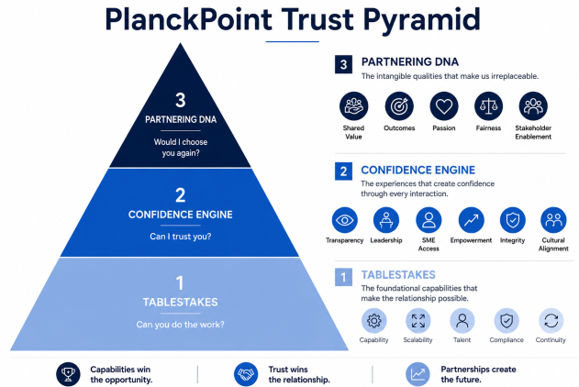
While trust has always mattered, what's new is that it no longer must stay invisible. Organisations that learn to see it, in numbers, on a dashboard, in a renewal conversation, are the ones that will keep compounding it.
The Next Competitive Frontier
Trust influences whether clients renew contracts, expand strategic partnerships, share sensitive information and remain committed when programmes encounter uncertainty. Organisations already measure delivery performance, customer satisfaction, operational risk and financial outcomes with remarkable precision. Yet few systematically measure the one asset that increasingly determines all the others. As artificial intelligence continues to commoditise knowledge and capability, the next competitive advantage may not belong to the smartest technology provider. It may belong to the organisation that earns and measures the greatest trust. The organisations that define the next decade won't simply build better technology. They'll build relationships that technology cannot replace.
Our inspiration: Niklas Luhmann
Niklas Luhmann is one of the most influential German sociologists of the 20th century. His thinking was based on the philosophical tradition and at the same time the reception of a wide variety of concepts from modern science. From this foundation, he developed a functionalist-oriented systems theory, which claims to be able to describe all social phenomena in a theoretically consistent language.